2/10/08

Day 3-- Arrival at Tambopata Research Station

When at last we arrived at TRC, the sun was low in the sky; thus, our trek up the wooden stairs on the river’s muddy bank and through the dark jungle seemed all the more mysterious. After about 15 to 20 minutes, we emerged in a clearing facing the front porch of the lodge. Behind the scenes, staff had harnessed themselves to two-wheel carts and hauled our large luggage to the lodge. 

Macaw's- eye view of the compound
Porch and staging area. these pix were taking so long to open that i compressed them--a little too much so they are blurry
The guys and cart used to wheel our luggage to the research site

Kerosene lamps were lit, as well as candle chandeliers made of polished branches supporting brazil nut candle cups.


After washing our boots at the boot washing station and putting on our lodge shoes (Teva sandals in my case), we gathered on the porch and met Sally Láurente who was in charge of the lodge and its staff.

My muddy boots and the boot washing station
Sally explained the rules and layout and then gave us our room assignments:  Dean was in Room #1 with a single bed . . . #1 being closest to the dining area and farthest from the bathrooms/showers. Kathy Schroer and I were assigned Room #2. Joan and Diana were assigned to Room #3; Alice and Sheila were in #4, and Alan was in in room #5. We were paired according to age from oldest (Dean at 74) to youngest (Alice at 31), though Alan may have been younger than that. He’d been married only 6 months. Our guides roomed with the researchers (Adrián Sánchez and his nest climbers) in the far end of the lodge.

Sally Laurente, lodge keeper and Jhin Solis, naturalist
My room, first on the right, a loong way to the bathrooms; note the lanterns in the b.r. windows . . . one for each of us. Your lantern is lit in the morning when you have 4:30 research station; the person with the unlit lantern gets to sleep in until afternoon duty 

My bed and the foot of Kathy's bed; no screens

Though our bathrooms and showers were grouped at the end of a hall, they were similar to the ones at Posada Amazonas. Only cold water for showers, which none of us would have minded if the showerhead had not been about 7 feet up directly above the small square shower basin. There was no place to get out of the cold water or gradually ease in, so the first gush was a breathtaker.


After a fine dinner at 7:30 p.m., we had a study session re taking clay lick (colpa) data, even submitting for Alan’s perusal several test sheets of data based on written scenarios. We finally got to bed at about 10:30 p.m., steeling ourselves to the fact that each time our headlamps illuminated our suitcases, shelves, or walls, we caused la cucurachas to scurry.

2/8/08

Day 4--Training & Nature Walk

Thursday, February 7, 2008

This morning we were up at 4:15am ready for group introduction to colpa data gathering. We picked up our clipboards, donned our boots, gathered up stools and walking sticks, and off we hiked in the rain—down the trail to the boat.
Jhin at 4 a.m.,with our lunches (in plastic tubs) and snacks 
Me. already red-cheeked and mopping with the bandanna as I pick my way through boot-sucking mud on the trail to the boat
It is still dark when we set out upriver to the clay lick; we must arrive before any of the birds do
X marks the spot where we set up our observation point; we look with binoculars across the backwater at the clay lick (colpa)
Alan told us how to divide the face of the colpa into identifiable areas, and we all sketched a diagram to help us when we had colpa duty. Below is Jhin’s diagram, mysteriously mislabeled. It should be 1A, 2A 1B, 2B; 1C, 2C, & 3C

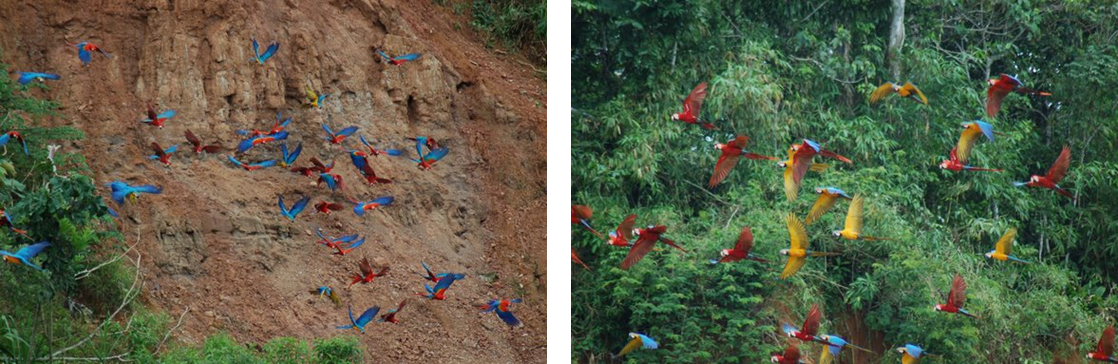
The following are some pix of the macaws, parrots, parakeets, birds, and animals we saw at the colpa. In the a.m. hundreds of birds would land to feed, the numbers gradually tapering off in the p.m. to only the large macaws, a few parrots, pigeons, piping guans. Though Sheila saw dusky titi monkeys on the colpa one evening too.
A feeble shot across at a portion of the colpa from our vantage point on the island; the faint green line on it is feeding mealy and blue-headed parrots; Mealy parrots and blue-headed parrots  
Red-and-green, or green-winged, macaw (Ara chloroptera) showing its personality
This photo was actually taken on our last day (can you tell I have an aching back?), but it is representative of our first visit to the colpa where Alan and the other guides identified, and taught us to identify, the macaws, parrots, parakeets and other animals and birds that fed at the colpa; Right: Red-and-green Macaws. 
Internet photos--Scarlet Macaws (Ara macao);right photoBlue-and yellow, or blue-and-gold, Macaw (Ara ararauna)
Internet photos--Red-and-green, or green-winged, macaw (Ara chloroptera); right photo two Scarlets fly past
Scarlets, Red-and-green, and Blue-and-yellow Macaws during a “flush”; right photo: Scarlets and Blue-and-yellow Macaws during a “fly-by” 
Chestnut-fronted Macaw (Ara severus). Chestnut-fronted Macaws can easily be confused with Red-bellied Macaws from the back but not when seen from the front (see below and right). Their heads and eye patterns are quite different also.
Several Red-bellied Macaws (Orthopsittaca manalita) (lower right in photo above) share the colpa with Mealy Parrots and Chestnut-fronted Macaws in this Internet photo
Left: Mealy Parrot (Amazona farinosa); Mealy Parrots would come to the colpa in large noisy flocks; they were one of the first birds on the clay in the morning. The photo on the right is shows the chestnut "fronts" on the Chestnut-fronted Parrots well; this bird is something like our Red-bellied Woodpecker. Its defining characteristic is not readily seen
Left: Dusky-headed Parakeet (Aratinga  weddellii); note the black bill; RightBlue-headed Parrot (Pionus menstruus), blue head and red undertail coverts; not to be confused with Blue-headed Macaw
White-bellied Parrot (Pionites leucogaster). This bird deserves a better name. It is absolutely stunning in the wild. Right:  Cobalt-winged Parakeet (Brotogeris cyanoptera). Don’t be fooled. When this bird flies, its underwings are brilliant blue. It flies in loud flocks that sound like jingling bells.
Yellow-crowned Parrot (Amazona ochrocephala), smaller and greener than Mealy Parrot; narrow orbital ring of bare skin; right:  Orange-cheeked Parrot (Pionopsitta barrabandi), another gorgeous bird on the wing in the wild as its underwings are brilliant red--see inset
Blue-throated Piping Guan. This bird came to the colpa nearly every day, sometimes in pairs, and always fed on 1A or 1B
Three pigeons came to the colpa: Pale-vented, Ruddy, and Plumbeous. It was hard to distinguish among them from such distance. All had red eyes, dark bills, and muted coloring; right Pale-vented Pigeon. 
Dusky titi monkeys on the colpa; photos taken by Sheila
About 7:30 a.m. after our morning training session at the colpa, we returned to TRC for a shower and then breakfast.

Note: Those brave enough to do so, took at least two showers a day. One could not move without becoming sweat-sopped—temps were in the 90s and humidity, too. Also it rained some portion of most days. My face was soon chapped because I wiped it so often with my bandana.

After breakfast—at which time a Chico came and stole pancakes (see photos below)—we were told how to take nest data. After practicing with scenarios, we were tested. There was a lot of information that needed to be gathered using binoculars, the video monitor, and our ears. One person would observe the nest box and its entrance while the other team member observed the monitor, taped episodes, and recorded the nest box visits and departures as reported by the member with the binoculars.
Tabasco sharing a stolen roll with mate on Dean’s clothesline; Notice how bedraggled their tail feathers get in the confines of the nest. Joan encouraging the thief’s bad manners; Pachanga approaching with the squirt gun in background.
Chico Tabasco checking out the breakfast buffet. These chicos (chicks) were hand reared. They have returned to and are nesting in the wild but often come in the morning to check out the breakfast fare. We were told not to encourage them.; Right: A Red-and Green Chico brazenly helping itself 
Tabasco chased to the rafters with a squirt gun. Macaws are  adept with bills and feet at holding and opening things; here it eats a breakfast plantain chip.
After our morning colpa study session we had  lunch, a bit of time off for naps and whatever before a 3:00 p.m. nature hike with Richard, Jhin, and Fino.

Alice and Jhin reviewing their notes; Jhin fell for Alice on Day 1
From a bird lovers point of view, TRC's location is not only unique because of its proximity to the macaw clay lick, but also because it is within a half-hour walk from seven distinct rainforest habitats with their respective transitions. Within an area of less then three square miles, we had well-studied samples of three  types of terraced floodplain forest, terra firma forest, bamboo forest, palm swamps, and the TRC clearing itself. Additionally, less than five minutes by boat, we had trails around a drying oxbow lake and up a tranquil stream. Each of these habitats had distinct vegetation compositions, which in turn harbored finely adapted bird, insect, mammal, reptile, and amphibian communities.

Many of the bird species registered around TRC can be found only in one or two of these habitats. The TRC’s 20-mile trail system, covers all of these habitats, producing a bird list of more than 480 species for the trails alone (not including the birds seen along the Tambopata River or the large oxbow lakes in the Tambopata area). This is an astounding number considering that few U.S. states can boast this many species in the entire state.
Our three naturalists, Fino, Richard, and Jhin
Richard called the birds in with his iPod and then used a laser pointer to show us where the bird was. I thought this very clever, but others told me that laser pointers were de rigeur for South American guides.

On this hike we saw white-lipped peccaries again and more squirrel monkeys. We also saw a Buff-throated Woodcreeper, Spectacled Antpitta, sooty antbird, Silver-beaked & Red-crowned Tanagers, and a Gilded Barbet. We also heard the Plain Tinamou and Lawrence’s and Black-billed Thrushes.

Internet photos of Red-crowned Ant Tanager; R- Silver-beaked Tanager

Gilded Barbet (Internet)
I have a poor aural memory so asked several times what bird belonged to the melodic song of the Lawrence’s Thrush. Of course we also saw other interesting flora, fauna and insect life too numerous to list.
Lawrence's Thrush (Internet)

This terra firma hike was wonderful but long. We returned from it after 6 p.m.—shamefully late for a nest box video that Alan had scheduled. But, despite being hot and sweaty, we quickly cleaned our boots, put on our lodge shoes and socks, and hustled over to staff quarters where the video player was.

Alan showed us on the video monitor what the chicks looked like in their nest cavities (nest boxes), and told us what to note or record.

The birds were crowded into the small area, and alternately preened, begged for food—which the parents fed them from their crops with convulsive movements—climbed the walls (literally), or pecked at the substrate, which was alive with roaches. Macaws don’t eat insects, so their substrate pecking simply stirred the critters up and we’d suddenly see feelers or a roach up-close-and-personal on the monitor screen.

Alan also put up our schedule for the week. We were paired for either morning or afternoon colpa or nest data gathering. This meant that we were free half of the day, either in the morning (4 am to 10:30 am) or the afternoon (after 11:30 am).

There were three nests being monitored and these combined with the colpa monitoring meant that four teams of two went out each day. Since there were only seven of us, Alan rotated the guides in, and each guide paired with an Earthwatcher for one duty.

After the video we had a good supper, and then we all showered, set out the clothes and equipment we’d need for our assignments the next day, and fell into bed at 9 p.m.to the sounds of thunder, lightning and rain.

Day 5--Jhin’s Commando Hike

Friday, February 8, 2008

Alice and I were scheduled for afternoon colpa observation, so had the morning free until departure at 10:30. Alan explained that if it rained, the colpa assignment would be cancelled. Sure enough, it rained all night and morning but it slacked off so the morning colpa team left anyway, but a bit later than usual.

At breakfast Richard and I went over my bird checklist and then I took a solitary trail hike, mentally noting turns and landmarks so that I could find my way back to TRC . I took many photos of the foliage, fungi, trees, and insects. Here is a sampling

Philodendron vine climbing to the sunlight; R - This vine with its little fungi umbrellas reminds me of Dr Seuss. I expect Dooungi to emerge from their fungi and sing or dance or something
Clay ant tower and interesting little vine just beginning to climb a walking palm to  the sunlight
Small ferny leaves establishing themselves on a tree; R - Drip tip and pink and blue berries—a baby bush?
Heliconia variety; Twin leaf?
Beautiful pink leaves struggling for sunlight for chlorophyll production; Juicy red flower; 
red was the predominant flower color
Motmot burrow nest . The blue-crowned motmot, is not the type of bird one would expect to live in a burrow.

Protection from climbing vines
Batwing? No just chicken in my lunch box
At 10:30am I met Alice and Jhin under the porch portico. We gathered our plastic lunch boxes  our snacks of cookies, orange, apple, crackers, and a weird bar of what seemed to be tiny round seeds glued together with something. We tucked all these things into our day packs, filled our water bottles, donned our boots, strapped our day packs and ponchos around our waists, picked up our clipboards, hiking sticks, and extra stools (to set our packs on out of the mud). . . and thus armed, struck off down the trail to the river and the boat that would take us to the island opposite the colpa. Some trees grow thorns on their trunks to protect themselves from smothering vines (see above right).

As we neared the colpa, Jhin radioed the morning team to see if there were any birds on the clay. There were, so we were dropped off at the extreme near end of the island so as not to disturb them. This led to an interesting hike that we later called Jhin’s Commando Hike.
Muddy trail and a large tree with buttress roots
Jhin had not been on the island for over a year and so immediately got lost. After climbing up the steep, muddy point, he led us through exceedingly deep mud and close stands of bamboo and other trees in search of the trail. After 20 minutes of hard going, in which our boots were repeatedly sucked off, we came to what appeared to be a dead end. A 6- or 8-foot pile of driftwood blocked our forward motion. Seemingly undaunted, Jhin climbed to the top of the pile and motioned us to follow. We did, under protest. Remember, we are each carrying a stool and clipboard as well as our hiking stick . . . and this EW tour of duty was rated “easy.”

Jhin and Sally on a later Commando Hike
The driftwood pile stretched the length of a football field, so was fertile ground for a twisted ankle or broken leg. But, Jhin bounced up and down on the logs before we stepped onto them, and I thought this a gallant effort to see if they were sturdy enough to hold our weight. No so. When we finally got off them—into the worst quagmire yet— Jhin said that he was bouncing on the logs to scare off snakes. I think maybe he was pulling our leg.

When we finally got off the driftwood, Jhin told us to wait while he scouted for the trail. While waiting, I took the photos below just to verify the terrain we were wallowing, slogging, and hacking our way through—yes hacking. Jhin had to use his machete more than once to clear a path.


All told, it took us 45 minutes to reach the impatiently waiting morning team (intensive 6-hour shifts are tiring). We gave them instructions about how to get back to the waiting boat, but they really didn’t need any. They could easily follow our boot holes.

Later we heard that they had a much easier time of it as they knew where the trail was. Even so, my roomie, Kathy, twisted her ankle, which laid her up for several days. She stayed at TRC and input data on the computer during her convalescence.
The colpa station
Finally at our station set up in the heat and humidity
To heck with the hat, boots, and socks. It is just too hot. We heard many gruesome bug stories, but none about hookworm or any that entered one’s feet through the soil 
Alice and Jhin scoping out the birds across the water on the colpa; notice how sweat-drenched they are. We all wear long sleeves and hats to protect us from burrowing and biting bugs

 After the initial groups of birds, it began to slack off on the colpa. Two heavy rainstorms passed through also, lessening the numbers on the clay. But, this gave us time to take photos and to look at other birds in the area.

Airplane Grasshopper. It flew with
a flash of white
Along with chestnut-fronted and the large macaws, we observed cobalt-winged parrots, Violaceous Jays, and Purplish Jays as well as two blue-throated piping guans and ruddy and pale-vented pigeons on the colpa. We also saw a ringed kingfisher near its nest hole in the clay bank, and on our side of the river, Greater and Smooth-billed Ani’s, Great Kiskadee, Tropical Kingbirds, Fork-tailed Palm Swifts, and the tedious, repeated call of the Undulated Tinamouwhoo whoo-whoo, whoo whoo-whoo, whoo whoo-whoo on a rising note.

Large, long-legged spider and Undulated Tinamou; tinamous are heard much more often than they are seen
The spotting scope pointing toward section 3C of the colpa; unknown species of butterfly alights on the spotting scope


Purplish Jay (Cyanocorax cyanomelas); snuggling Smooth-billed Ani's (Crotophaga ani); Greater Ani (Crotophaga major); Internet photos 

Violaceous Jay (Cyanocorax violaceous) in cecropia tree; Forked-tailed Palm Swift 

At five we radioed for the bote bote, and at 5:20pm we finally heard our boat chugging toward the island. Since there were no birds on the clay, the boat could come close to our observation site, saving us the difficult hike back to the point. It pulled up to a little river bisecting the island a short hike from us. This river is purported to have caimens on it further up, but I never got a chance to explore it. Never saw a caimen on the entire trip. The river runs too high and fast for them and we did not see any on our next-to-last day at the oxbow lake.

Adrian and his team of tree climbers had been monitoring the three macaw nests on the island, so they piled into the boat with us. We were all hot and tired and very grateful to be going toward a shower and supper.
The bote bote coming to get us

A tired Adrian and Alice; Jhin and the boat captain enjoy their common language after a long afternoon 

I look mad but am really only hot and tired on the way back to  TRC
After supper, Alan gave us a PowerPoint presentation on the Macaw Research Project, explaining that a range of animals come to satisfy their need for salt or the soothing effects of the clay along the river banks of the region. These clay licks provide a regular wildlife spectacle that forms one of the fundamental attractions of the rainforests. It seems that geophagy in vertebrates may be due to all of the following factors:
-- Adsorption of toxic plant compounds onto clay particles and gastrointestinal protection
-- Mineral supplementation
--The clay minerals in the soil possibly alleviating stomach upset or diarrhea
-- Mechanical enhancement of digestion

My eyes were so tired after staring through the binoculars all afternoon that I could barely bring the slides into focus. Alan had scarcely clicked off his computer before I was in bed (about 9 pm), having first laid out all that I would need in the morning.